



Since the dawn of history, humankind has been puzzled by the world of the jinn — that hidden realm intertwined with human belief, imagination, and fear. Among all the kinds of jinn, the name “Ifrit” stands out as the most mysterious and awe-inspiring. It appears in ancient texts as a symbol of power and cunning and has held a special place in folklore and magical rituals, becoming synonymous with a rebellious or crafty spirit endowed with supernatural abilities.
Meaning and Origin of “Ifrit” in Language and the Qur’an
In Arabic, the word “ʿIfrit” (عِفريت) derives from roots meaning cunning, intensity, and skill in deception.
It is mentioned in the Qur’an in the story of Prophet Solomon (Sulayman) and the Queen of Sheba (Bilqis), when one of the jinn said:
“An ifrit from among the jinn said, ‘I will bring it to you before you rise from your seat.’”
(Surat An-Naml, 27:39)
Here, the ifrit appears as a strong and swift being with powers beyond ordinary jinn — yet still subject to the command of Prophet Solomon. This indicates that its strength is great but not absolute; it remains under God’s will.
Types of Jinn and the Ifrit’s Rank Among Them
Traditional lore divides the jinn into several categories:
-
Marid: A giant, mighty jinn known for physical strength and rebellion.
-
Ifrit: Distinguished by intelligence, cunning, and balanced power — often depicted as a leader or intermediary between marids and common jinn.
-
Qareen: A companion spirit linked to a person’s psyche.
-
Shaytan (Satan): A rebellious jinn who defies God’s commands.
Thus, the Ifrit is not merely a type of jinn but a rank within their hierarchy — combining mental sharpness with formidable power, often portrayed as a strategist or manipulator.
The Ifrit in Arab and Islamic Folklore
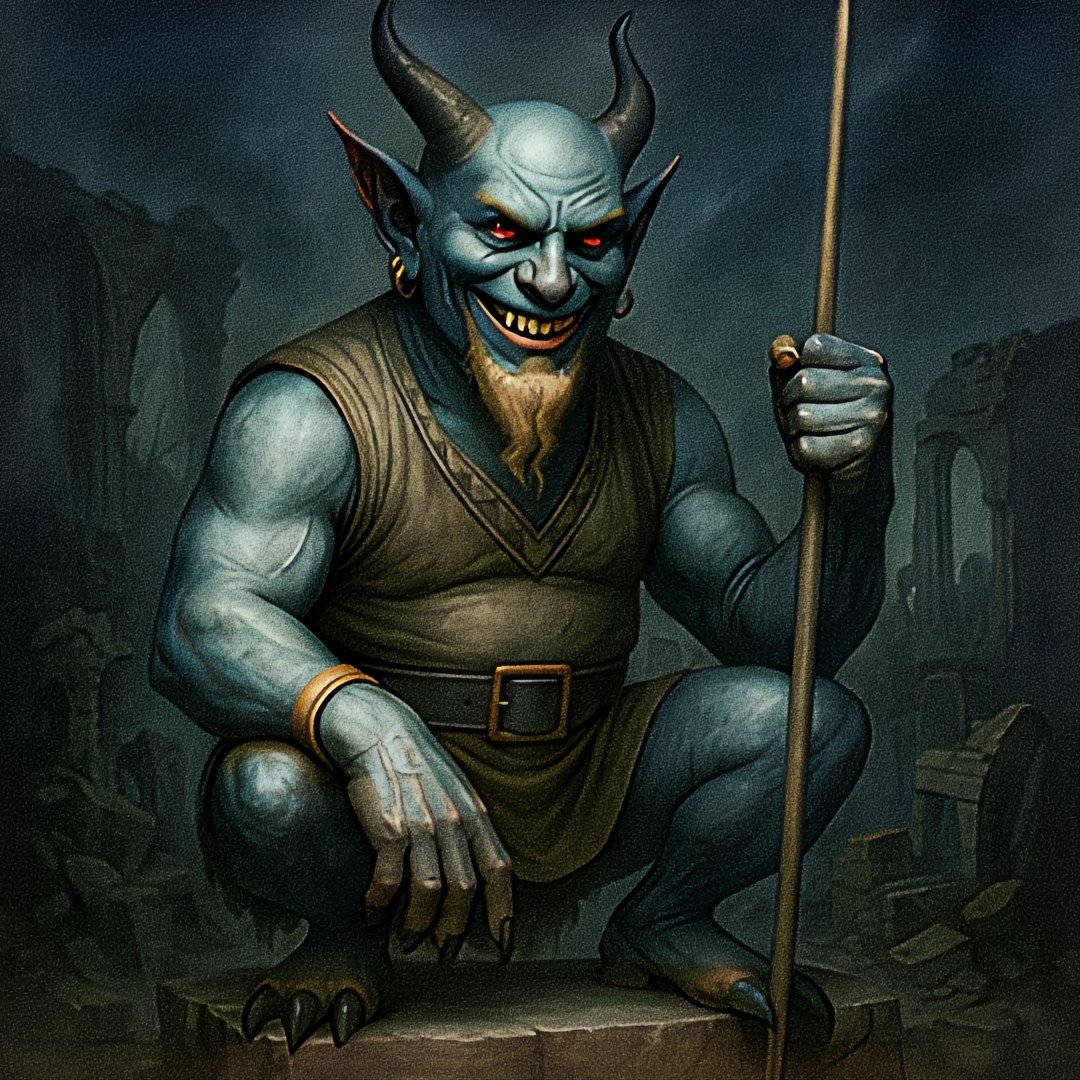
In Arab folklore, the ifrit is seen as a being that appears in deserted places, emerging from graves or ancient wells. It is often described as tall, with eyes glowing like embers and a voice deep and echoing like stone.
Old tales recount that an ifrit can take the shape of a human or animal and speak fluently to deceive sorcerers or trick them. Some ifrits are said to guard buried treasures that can only be revealed through blood offerings or special incantations.
The Arabic saying “He’s an ifrit” is still used today to describe someone who is exceptionally clever, mischievous, or hard to deal with — likening him to the cunning spirit itself.
Ifrits in Myths and Legends
In ancient Egyptian stories, the ifrit was associated with “guardian spirits” of tombs and temples.
In Levantine and North African folklore, tales tell of “the Ifrit of the Lamp,” a being that obeys whoever summons it — a figure later blended with the “Genie of the Lamp” in One Thousand and One Nights.
In rural legends, ifrits are said to dwell near ancient trees or streams, appearing at dusk or taking on different forms to lure people into madness or ruin.
The Ifrit in Magical Practices
In old grimoires such as Shams al-Maʿarif al-Kubra and al-Toukhi’s works, the ifrit is listed among the powerful spirits summoned to perform difficult or forbidden tasks.
It is claimed that sorcerers invoke ifrits to deliver messages, enslave other spirits, or harm enemies — through seals, talismans, and rituals often tied to malefic planets like Saturn or Mars, using black or blood ink.
Ancient magical manuals describe in detail the “enslavement of ifrits and marids”, which allegedly involves:

-
A 40-day retreat or “khalwa”, in isolation and fasting.
-
Reciting mysterious names and incantations (azā’im).
-
Drawing sigils and seals on the ground or on animal skin.
-
Burning specific incense like frankincense, benzoin, and blood.
The ifrit supposedly manifests first as a smoky or shadowy figure, then takes on a semi-human form. It is said that it obeys only after a written “pact” made with impure ink or blood — yet folklore warns that the ifrit is deceitful by nature and may turn against its summoner, driving them to madness or possession.
The Ifrit in Islamic Religious View
The Qur’an affirms that jinn — including ifrits — are intelligent beings created from smokeless fire, unseen to humans unless God allows it:
“Indeed, he and his tribe see you from where you cannot see them.”
(Al-Aʿraf, 7:27)
Islamic scholars emphasize that anyone claiming to control jinn or ifrits does so through forbidden acts of sorcery, involving pagan rituals and demonic alliances.
Such pacts are considered shirk (idolatry) because they require obedience to devils in defiance of God.
Therefore, from a religious standpoint, it is impossible to command an ifrit lawfully; its fiery, rebellious nature prevents it from serving humans — except when God wills, as in the story of Solomon.
Psychological and Parapsychological Interpretations
Parapsychologists and researchers of the paranormal interpret the summoning of an ifrit as a psychological projection or energy manifestation of the subconscious. The practitioner, during long isolation, may experience auditory and visual hallucinations due to:
-
Sensory deprivation and lack of sleep.
-
Repetition of rhythmic sounds or symbols.
-
Activation of deep subconscious imagery that manifests as an “external entity.”
In other words, the “ifrit” seen by a magician might be a psychic projection from their own mind rather than a real creature. However, to the experiencer, the event feels vividly real — while others believe these beings exist in another dimension intersecting ours only under rare or ritual conditions.
The Ifrit in Literature and Popular Culture
The ifrit has appeared in children’s tales, classic Egyptian plays, and old films — such as “My Wife’s Ifrit” or “The Ifrit” starring Omar Sharif — often portrayed humorously, as a witty and mischievous being hiding a darker side.
In modern supernatural literature, however, the ifrit has taken on a darker and more terrifying image — a being that feeds on human energy, associated with nightmares and demonic possession.
Conclusion
The Ifrit remains a puzzle suspended between religion, myth, and science.
Is it a real being of fire as described in Islamic tradition?
Or merely a symbol of cunning and power within collective imagination?
Whatever the truth, the ifrit’s enduring presence in Arab culture reflects humanity’s deep fear of the unknown — and its eternal fascination with what lies beyond the veil.
That sly, fiery creature standing between light and darkness will forever symbolize everything that defies our understanding of the hidden world.
About Kamel Ghazal
Kamel Ghazal is a Syrian researcher in the field of the paranormal (metaphysics), born in 1971.
He is the founder of Paranormal Arabia, the first Arabic platform dedicated to this unique domain since 2008.
Also Read:
-
The Dwarf Ifrit: The Truth Behind the Legend
-
The Jinni Sakhr and Solomon’s Ring
-
The Ifrit’s House (A True Story)
-
Jinn in Islamic and Mythical Thought
-
Existence, Manifestation, and Influence of the Jinn – “Jinn and Devils” Series
-
Major Jinn Figures in Arabic Magical Rituals
-
Zawbaʿah: Lord of Chaos and Terror
-
Al-Sawda’: Mistress of Infernal Rites in Arabic Magic
-
Maymoon al-Sahabi: The Sky-Jinn Who Rides Clouds and Reveals Secrets
-
Maymoon al-Nikah: Master of Lust and Seduction Rituals
-
Abu Mahrez al-Ahmar: Lord of Fire and Blood
-
The Ifrit (Artistic Work)
-
“Afarit Hossein al-Imam” – TV Program