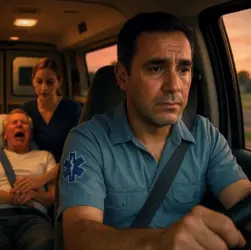






The Light at the Hour of Departure: Reflections from an Ambulance Driver
I work as an ambulance driver for critically ill patients. My training is rigorous — CPR, first aid, annual proficiency tests, and surprise screenings for drugs and alcohol — ensuring I can handle life-and-death situations. Every day, I transport patients from their homes to clinics and hospitals, often forming long-standing routines with some of them over months or even years.
Over time, I noticed a strange and recurring pattern. Many patients describe seeing a bright light in the sky, like the sun rising at 10:00 a.m., filling them with overwhelming joy — a sense of being children again, calling for their parents. Despite illness and suffering, they experience a profound happiness. Strangely, these visions often precede their death, sometimes by days, sometimes by years. The kindest and most moral patients tend to have the longest interval between seeing this light and their passing. The presence of compassionate people seems to amplify this phenomenon.
For example, a young nurse with braided hair and a cheerful demeanor had a remarkable effect on patients. Multiple patients described her as surrounded by a warm, radiant aura, intensifying their visions of light and joy. When I mentioned this to her, she initially seemed unsettled, but eventually confessed, “They see what we don’t see, and I’m scared.”
I also noticed that patients who pray or meditate regularly seem to radiate a stronger aura. Conversely, those in constant pain, sleepless, or burdened by despair often see no light and long for death without relief.
Once, a woman in deep pain grabbed my arm, pleading, “I want to die, help me.” I told her I couldn’t. She whispered, “You are one of them; you can help me.” I placed my hand on hers and said, “May your departure be easy, quick, and painless.” She smiled faintly. “Thank you. That’s what I need,” she said.
It struck me how people choose their path: some become angels of mercy, while others become shadows of despair. Peaceful lives often lead to serene departures; bitterness or cruelty may prolong suffering even in one’s final days. Life, and perhaps death, mirrors the choices we make.
The Overflow of Faith and Ease of Departure
True faith isn’t mere belief in doctrine — it is a deep emotional state that prepares the soul for departure. It views death not as an end but as a passage, accompanied by someone or something waiting — the “father or mother” that patients describe, or the mercy of God in our understanding.
This faith creates what some call spiritual surrender, where fear is replaced with serenity. Ways to ease the transition often include:
-
Belief in divine mercy
 ADVERTISEMENT
 -
Frequent prayer and meditation, creating a visible aura of peace
-
Reconciliation with oneself and others
-
Living a life rooted in love rather than resentment
On the other hand, a life dominated by negativity, hatred, or regret may produce existential distress, reflected in the dying process:
-
Chronic insomnia, as if the soul resists rest
-
A desire for death as escape rather than transition
-
Darkness instead of light, emptiness instead of joy
As traditions remind us: “A person dies as he lived… and is resurrected as he died.”
While we may not have a definitive explanation for these phenomena, we do have choices:
-
To live in the light, to face the dark without fear
-
To fill our hearts with compassion, leaving a legacy of love
-
To leave behind a life that illuminates our final moments
Prepared by: Kamal Ghazal
Note: These stories are published based on the author’s knowledge and classified as real experiences, without claiming absolute veracity. For more on why these experiences are shared and how to engage in constructive discussion, read here.
Also Read:
-
Near-Death Experiences: Stages and Insights
-
Evidence of Life After Death or Brain Phenomena?
-
Last Words of the Dying
-
Research Centers Exploring Life Beyond Death
-
Real-Life Experiences: An Unforgettable Night in an Ambulance